Meta / Contents
Nobody Told Me to Stop Thinking
A review comment went out under my name on a React PR, and I'm not a front-end developer. Wharton calls that cognitive surrender, and their data says the clock causes it. Nobody at work told me to hurry. They didn't have to. This is about the pressure, the half of it that's mine as a lead, and two things I'm trying.
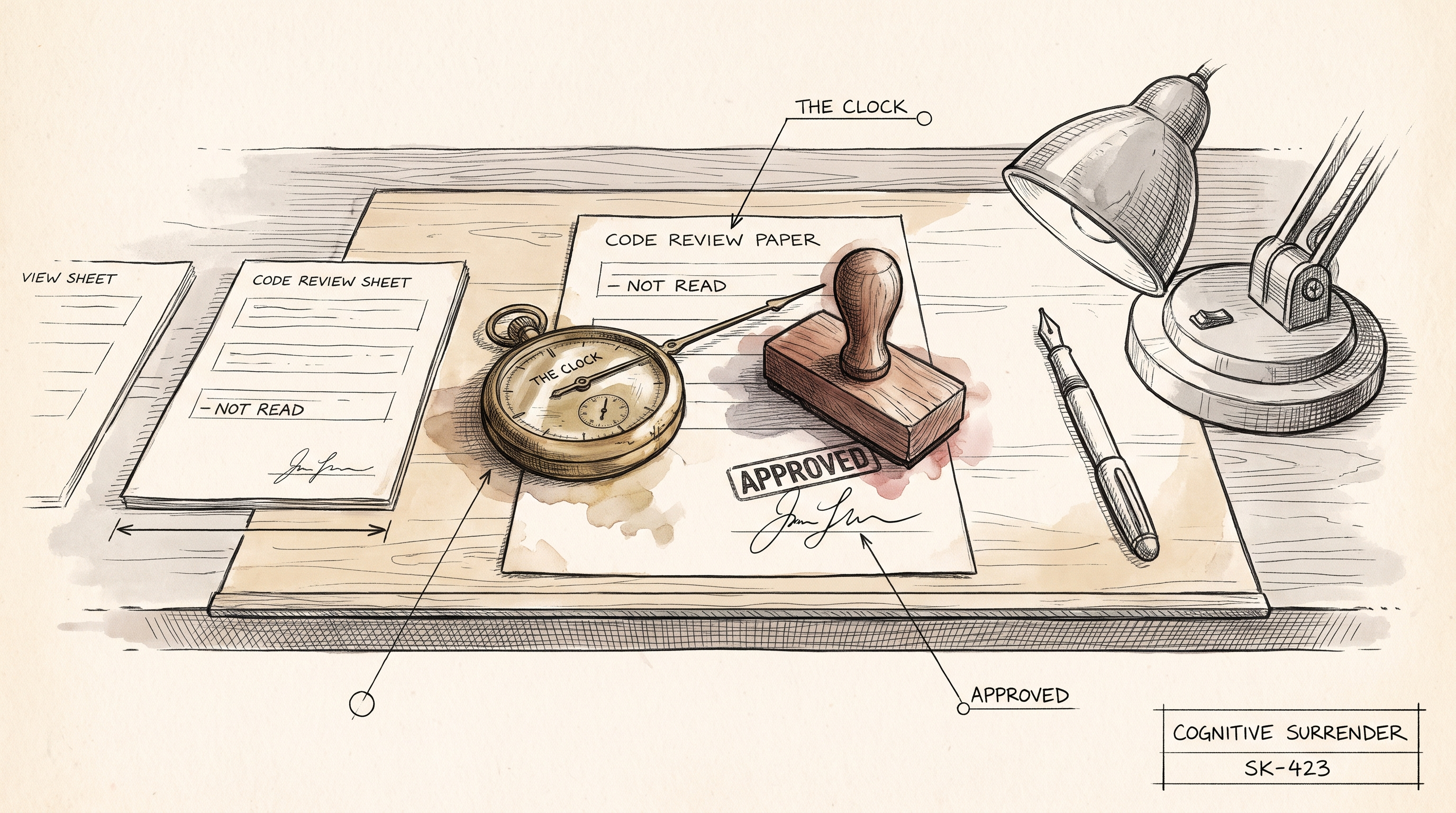
A pull request landed in my review queue late on a Thursday. A React component, a few hundred lines, from a teammate who needed it merged before the end of the sprint.
I am not a front-end developer. I've spent three decades on the server side, and I lead a team now that ships plenty of UI. Almost all of my own pull requests come out of the agentic process I've written about all year, and most of my reviews start the same way: I hand the diff to Claude Code and ask what it sees.
It saw a problem with how the component handled state across renders. It explained the failure, suggested a fix, and drafted a comment. The comment was clear and specific. I read it, it sounded right, and I posted it. The author thanked me, made the change, and the PR merged that evening.
A week later, in standup, I asked how that component handled its state. A reasonable question from a lead, except I was the one who'd reviewed it. The fix had gone in on my comment, and here I was asking the author to walk me through the thing I'd supposedly caught. I couldn't tell you why the original code was wrong. I'd never known. The judgment in that comment was the model's, and I'd signed it.
The details here are blurred. The shape is real, and it wasn't the first time.
Here's the part that took me longer to see. Nobody asked me to review that way. No one at work has ever told me to go faster, skip the reading, or let the model decide. The clock did that on its own.
The handoff I didn't notice
There's a name for what happened on that Thursday. In a paper titled Thinking, Fast, Slow, and Artificial, Steven Shaw and Gideon Nave at Wharton call it cognitive surrender: adopting an AI's answer as your own without noticing that the decision changed hands.
They're careful to separate it from offloading. A calculator does the arithmetic while you stay in charge of the problem. Surrender is when the tool makes the call and you carry it forward as yours.
Their experiment is simple to describe. More than a thousand people worked through reasoning puzzles with an AI assistant on hand, and the assistant had been rigged to be confidently wrong some of the time. When people asked it and it was wrong, they went with it about four times out of five. Their confidence went up either way, including after the misses.
That second finding is the one I keep coming back to. The thing that should have stopped me on Thursday, the feeling that I didn't understand what I was posting, is the signal that goes quiet when the assistant is in the room.
Last month I wrote about the cognitive debt I'd run up, the gap between what my agents shipped and what I understood. Surrender is how the debt gets there. Debt is the balance. Surrender is the transaction.
The friend from that post, a former colleague, tried the /learn skill I'd shared. Ten minutes into a session on a new ticket they messaged to say it was already paying off, then got annoyed when they had to drop it to patch an earlier PR. They've since started writing out their own mental model of each area as they go, by hand, alongside what the skill shows them. That last part is the whole point, and they found it on their own.
Delegating is a decision. Surrender is the absence of one.
I want to be careful here, because I've spent a year arguing that most of my work should go straight to agents. The factory still runs, and I'm not taking those posts back.
The line I've landed on is this. Delegation is a handoff I decided on and can check. I know what I gave away, I know how I'll verify it, and I could have told you both before the work started. Surrender is the handoff I didn't notice making. Usually because the clock made it for me.
Shaw and Nave concede that deferring to a system that is more accurate than you is rational on structured, well-defined tasks. I agree. A dependency bump, a help article rewrite, a bug fix in a module I know: the factory takes those and I sleep fine.
The test is whether I could have described the handoff in advance. On the Thursday PR I couldn't have. I didn't decide to let the model review a React component for me. I let it, because there were six other things in the queue and the comment read well.
Compare that with the PR I described in the debt post, the one I approved because the tests passed and the shape looked right. That one was surrender too, and I called it skimming. Same thing, different name. Both times the clock was in the room and I wasn't.
The clock is the mechanism
The same researchers tried two more things. They put people on a 30-second timer, and surrender went up. They paid a few cents per correct answer and showed people whether they'd got it right, and people started overriding the assistant when it was wrong. Pressure buys surrender. Rewarding accuracy buys it back.
That's a lab. Here's what it looks like at work.
A pair of researchers spent most of last year inside a tech company that never mandated AI. It bought the subscriptions and got out of the way. People sped up anyway. They took on wider scope, worked more hours, and the engineers ended up spending more of their week finishing colleagues' AI-assisted code. The expectation for speed rose without anyone setting it. It rose because of what everyone could see.
Elsewhere the clock was more explicit. About half of the desk workers in one survey admitted sending colleagues AI output they knew was weak, and the reason they gave was that they were stretched too thin under a mandate to use the tools. Some companies went further and ranked engineers by how many tokens they burned, then dropped the idea when the code that came out of it wasn't worth the leaderboard.
Strip the studies away and the pattern is the same one I'd describe from my own week. Most places reward output as fast as it can be produced. A person who wants to keep thinking is paying for it out of their own evaluation, and overloaded people use whatever tool they're handed to speed up the work they already have. Nobody upskills on a deadline.
None of these companies told anyone to stop thinking. They provided the tool and kept the clock running. That was enough.
I am the clock
That's the half of this post that's easy to write. Here's the other half.
I'm a tech lead. The pressure I've been describing doesn't stop at me. It passes through.
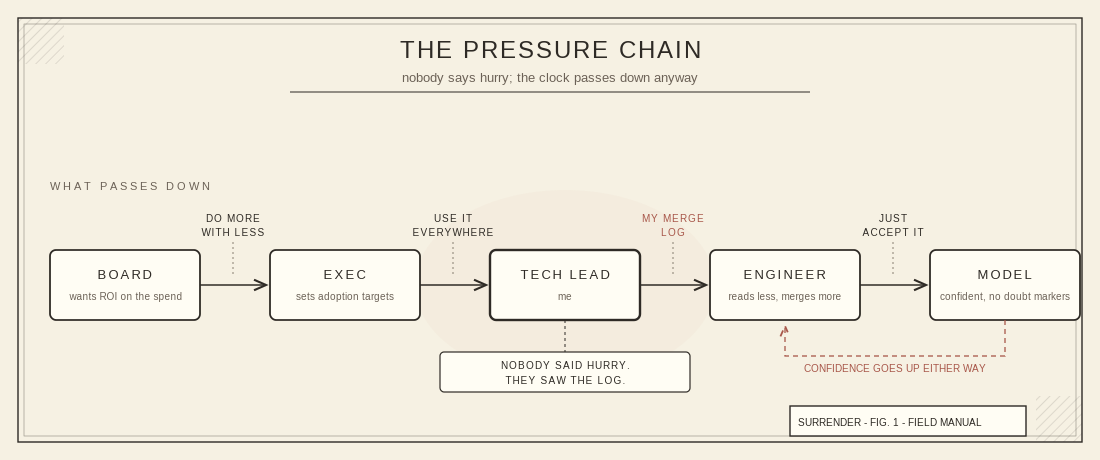
I've never told anyone on my team to hurry. I've never said "just accept what the model suggests." I checked, as best I can, and I don't think I've ever implied it either.
I didn't have to. They can see my merge log.
The norm for speed gets set by what's visible. My output is visible. It's visible at work, where my PRs come out of a pipeline and land at a pace a person typing can't match. It's visible here, where I've published 99 pull requests merged into TutorPro in a week and a whole post titled 19 Days, 239 Commits. I wrote that one as a story about restraint. The number is still in the title.
So when a teammate opens a Thursday PR and has a choice between reading the diff and accepting the model's take on it, the clock they're hearing is partly me. I'm the person whose throughput makes reading feel slow.
That's an uncomfortable thing to write down. I'd rather it be uncomfortable than untrue.
Both, held
There are two easy answers, and I don't believe either of them.
The first is that it's the company's fault. Set the measures and the behavior follows, so fix the measures and leave the individuals alone. There's something to it. The clock causes surrender, and a company doesn't need to mandate anything for the clock to start.
But people differ under the same pressure. In that Wharton experiment, the people who trusted the assistant most surrendered most, and the people who liked thinking problems through pushed back and lost less. The conditions tilted the floor. Not everyone slid. My name was still on that review comment, and no incentive structure posted it for me.
The second easy answer is that it's on each of us. Read the diff. Slow down. Own your judgment. I've written that post, more than once. The trouble is that it asks people to lose a race the organization is scoring. If understanding the code costs you in the evaluation and merging it doesn't, telling people to understand the code is telling them to pay.
Here's where I land.
A lead owes the team time. Not a speech about craft. Time, visibly budgeted, so that understanding an area counts as work and shows up in the plan next to building it. If I don't put it in the estimate, I'm asking people to steal it, and most of them won't.
Each person owes the honesty. The sentence "I don't understand this yet" has to be sayable, out loud, in review and in standup, and it has to be the person's job to say it. A lead can make it safe. A lead can't say it for you.
Neither half works alone. Time without honesty is a budget nobody draws on. Honesty without time is a confession with no way to act on it.
Two things I'm trying
These are experiments. I don't have results, and I'll report back when I do.
Learn time goes in the estimate. When I size work in an area the assignee hasn't read, the estimate now carries an explicit line for understanding it first, which in practice means a /learn session before the spec gets written. If it gets cut, it gets cut in the open, by someone who can see the line.
I've stopped broadcasting volume. No more PR counts in standup, no more turnaround times as wins, and I'm including this blog in that. What I'm reporting instead is two things: what we can now explain that we couldn't last month, and what the work produced for the people using it. Understanding and outcomes. Activity numbers don't make the list.
The second one is harder than it sounds, because the volume numbers were true and they were flattering. Leaving them out feels like hiding something. I think it's the opposite.
Your turn
The Finish Line post asked for your ideas on quality, and the replies changed how I think about verification. I'd like to do that again, aimed at the people in the middle of the chain.
- Where did the clock make a call this week that you'd have made differently with another hour?
- What does your team see you reward? Not what you say you value. What gets the shout-out.
- If understanding went into the estimate on your team, who would push back first? Would it be you?
- From the outside, looking at a team's merged work, how would you tell delegation from surrender?
Answers in the LinkedIn comments or through /contact. If the replies are as good as last time, there's a follow-up in them.
Nobody told me to stop thinking. I'd like to be the kind of lead nobody has to tell to start.
–Jeremy